






You may also like
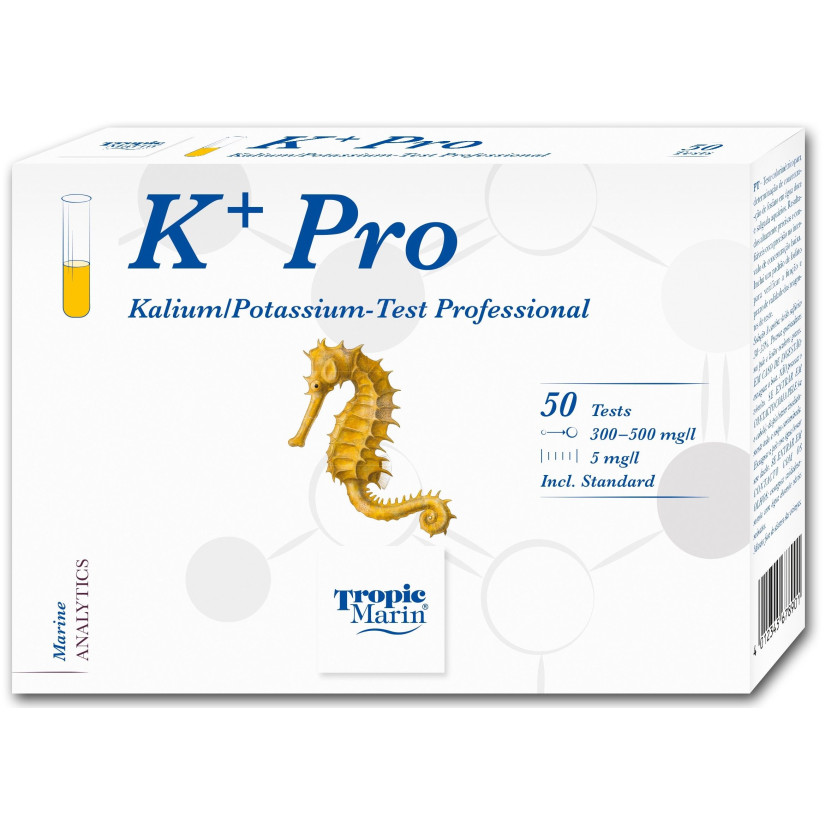
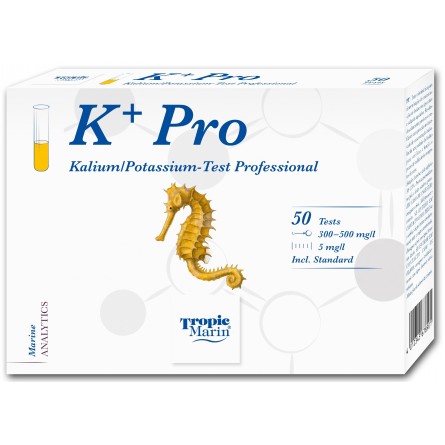
For determining the potassium concentration in saltwater aquaria
Potassium is an essential macronutrient for all living things. The alkali metal is present in seawater at an average concentration of 408 mg/l. In a saltwater aquarium, the potassium concentration can usually be kept at a stable level through regular water changes. However, a lack of potassium can occur in some aquariums due to the use of zeolites and other adsorbents. Severe coral discoloration and the introduction of polyps are a sign of a potential potassium deficiency. In a saltwater aquarium, the potassium content should be checked regularly and maintained between 380 and 420 mg/l.
This Professional Potassium Test from Tropic Marin ® reliably determines the potassium concentration with a resolution of 5 mg/l.
| • | Measuring range: 300 – 500 mg/l |
| • | Accuracy: 5mg/l |
| • | For the determination of the concentration of calcium and magnesium in seawater aquaria |
| • | Sufficient for about 50 applications |
| • | Includes potassium standard to verify function and shelf life of test reagents |
Note: The accuracy of measurement results can be increased by calculating a correction value. For this purpose, a measurement is carried out with the “Standard” reagent (potassium). This measurement provides a correction value that must be considered for each potassium measurement. We recommend resetting the correction value every 3-4 weeks.
1. Determination of the correction value:
| 1.1 | If you have recently determined the correction value, go to Point 2 “Potassium determination”. |
| 1.2 | Before use, shake the reagent bottles well! |
| 1.3 | Place a clean tip on the best-dried 1 mL dosing syringe with green plunger and draw up 1 mL “Standard”. Pour the entire quantity into one of the two bowls. |
| 1.4 | Now carry out the potassium measurement as described in point 2.3 to point 2.8. |
| 1.5 | The correction value can now be calculated using the table . For this purpose, the potassium concentration of the corresponding residual quantity of reagent D given in the table is used. Subtract this value (the measured potassium concentration) from the standard value of 400 mg/l (standard potassium concentration). This gives you the correction value that you will use for the measured values determined later. Example : |
| 1.6 | The glass cuvettes, syringes and syringe tips used must be thoroughly cleaned at the latest after carrying out the potassium measurements. |
2. Determination of potassium:
| 2.1 | Before use, shake the reagent bottles well! |
| 2.2 | Place a clean tip on the 1 ml dosing syringe with a green plunger, clean the syringe several times with the water sample to be analyzed (aquarium water) and then draw in 1 ml of this water. Pour the total volume into the second clean cuvette. |
| 2.3 | Place a clean tip on the 1 ml dosing syringe with the red print and draw up reagent A until it reaches the 20 mark on the syringe (which corresponds to 0.5 ml). Add the total volume to the water sample. The exact execution of this step is decisive for the accuracy of the end result! |
| 2.4 | Shake the cuvette with the water sample for 10 sec. To thoroughly mix the reagent and wait 5 minutes. A white turbidity forms. |
| 2.5 | Add 9 drops of reagent B, shake for 10 sec. and allow the cuvette to stand for an additional 2 minutes. |
| 2.6 | Then pour 3 drops of reagent C from the dropper bottle, the water sample then turns yellow. |
| 2.7 | Now place another clean tip on the third 1 ml dosing syringe with black print and draw up 1 ml of Reagent D. Add three drops of Reagent D to the water sample (CAUTION: Under no circumstances should case pour a larger quantity of reagent D at once into the cuvette) and mix the reagent correctly by swirling it carefully. This is important to get a clear transition point later. Repeat this procedure until the yellow color disappears and turns into pale pink. |
| 2.8 | After that proceed cautiously with the titration. After each drop of reagent D, the cuvette should be shaken until a dark pink color is obtained after approx. 1 – 3 drops. Note the remaining amount of Reagent D in the syringe. Note : If you are not sure whether you have reached the endpoint of the titration, add another drop of reagent D. If the color intensification does NOT increase any longer, the endpoint of the titration has already been reached. Then add the last drops (0.01 ml) to the remaining amount. If at this point you determine the correction value with the "Standard", go to point 1.5. For the actual potassium measurement of your water sample, please continue with point 2.9. |
| 2.9 | It is now possible to read, in table , using the residual quantity of reagent D, the corresponding potassium concentration. From this value – if indeed it has been determined – we subtract (negative value) or add (positive value) the correction value determined in point 1.5. Example : |
| 2.10 | If other measurements are carried out, the cuvettes as well as the syringe with the green plunger must be cleaned quickly with reverse osmosis water. After the series of measurements, the glass cuvettes must in particular be thoroughly cleaned immediately as indicated in point 3 so that there is not too much precipitation. |
3. Cleaning the glass cuvettes and syringes:
After a series of measurements, it is recommended to clean the glass cuvettes, syringes and syringe tips used.
– The syringes and corresponding syringe tips must be thoroughly cleaned with reverse osmosis water and left to dry.
– Thoroughly rinse the glass cuvette with tap water. Clean the bowl with a piece of paper towel, clean with reverse osmosis water and leave to dry. A light precipitation may remain. To remove it, we recommend using a suitable brush such as the Tropic Marin ® toilet brush (to be ordered separately) or adding kitchen vinegar or a vinegar cleaner. Leave the vinegar solution to act for 12 – 24 hours then rinse the bowl with reverse osmosis water and let it dry.