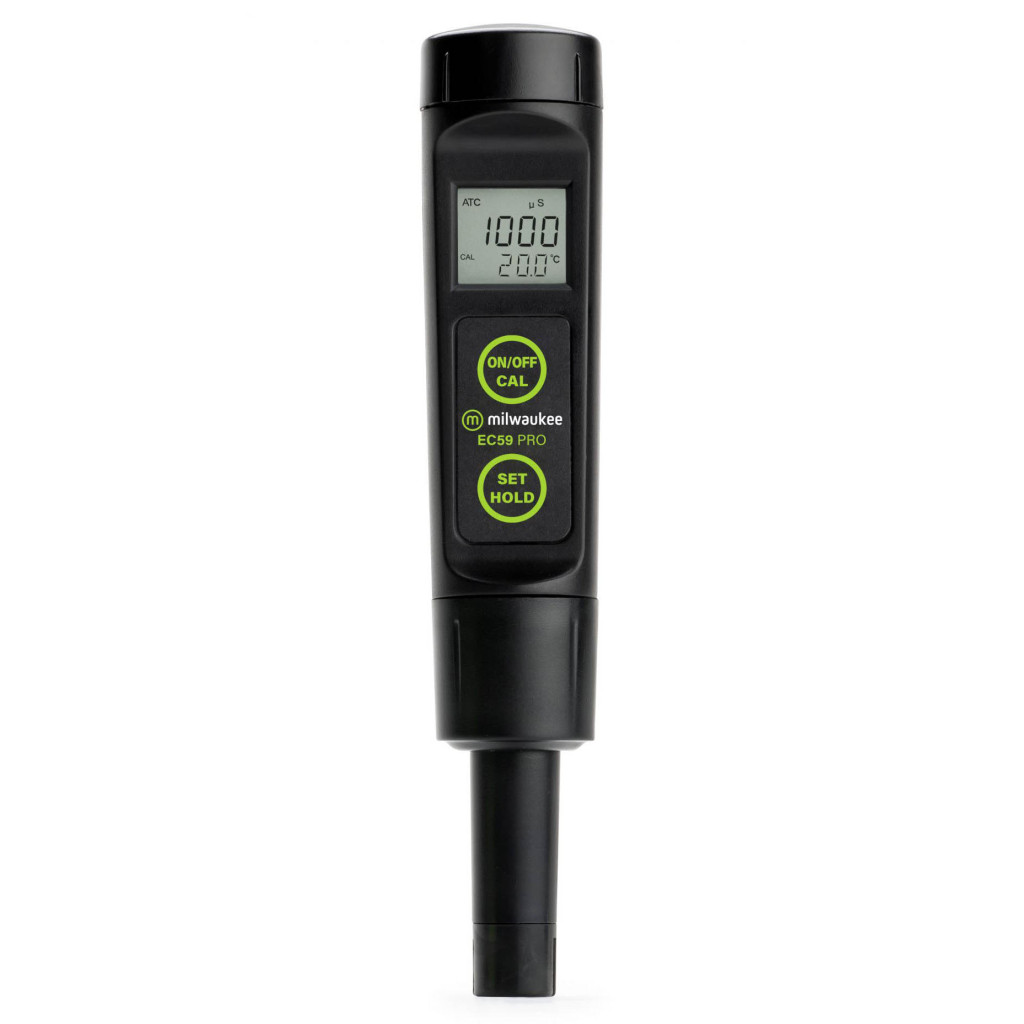









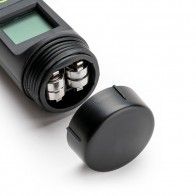


The Milwaukee EC59 Pro offers a stated accuracy of ±2% of full scale for conductivity and TDS measurements. This accuracy provides sufficiently reliable results for routine checks, installation monitoring, and regular comparison of multiple samples.
The conductivity of a solution naturally changes with its temperature. Without correction, two measurements taken on the same water at different temperatures may therefore appear inconsistent. Thanks to automatic temperature compensation, also called ATC , the tester corrects this effect to provide more easily comparable values.
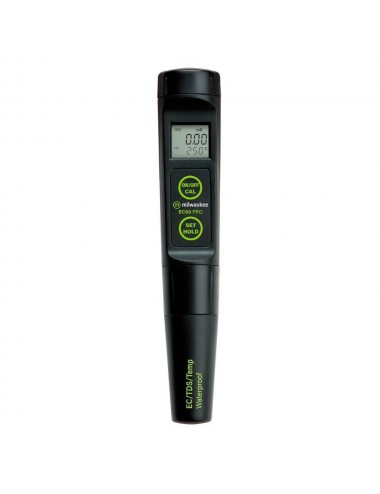
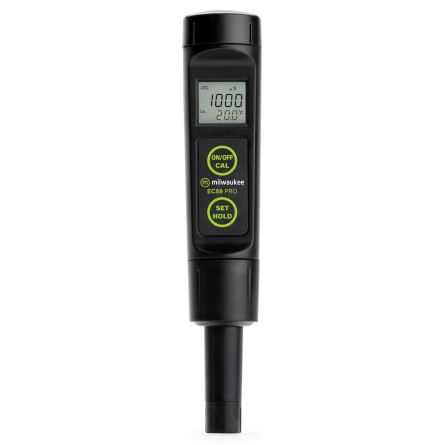
Its digital display clearly shows the results, simplifying its use even for someone unfamiliar with measuring devices. Simply immerse the probe correctly in the sample, wait for the display to stabilize, and then note the value obtained.
When a tool is used near an aquarium, tank, or irrigation system, splashes are difficult to avoid. The Milwaukee EC59 Pro features IP67 protection , which enhances its resistance to water and dust. This allows for more confident handling during routine checks or field operations.
Its compact size makes it easy to transport and store. It can be kept near maintenance equipment, taken on call, or used successively on several installations. Despite its waterproof design, it remains important to respect the maximum immersion level specified by the manufacturer to ensure the long-term preservation of the electronic components.
The probe is one of the most stressed components of a conductivity meter. It is regularly immersed in solutions with varying concentrations of minerals, salts, or residues. Over time, its condition can therefore affect the stability and accuracy of the results.
The EC59 Pro features a replaceable probe . In case of wear or damage, it is not necessary to replace the entire device. This feature improves its lifespan and makes it more economical to use, especially when used frequently in a professional setting.
Its battery life can reach approximately 300 hours of operation with a suitable set of batteries. A low battery indicator alerts the user when a replacement is necessary, thus preventing unexpected interruptions during a series of measurements.
Electrical conductivity directly measures a solution's ability to conduct electricity. It is usually expressed in µS/cm or mS/cm . Total dissolved solids (TDS) are expressed in ppm and are an estimate calculated from conductivity using a conversion factor.
However, there is no single factor that is valid for all solutions. Several scales can be used, including factors of 0.50, 0.65, or 0.70. A conductivity of 2.00 mS/cm, or 2000 µS/cm , corresponds, for example, to approximately 1000 ppm with a factor of 0.50. The same conductivity corresponds to approximately 1400 ppm with a factor of 0.70.
To properly compare several results, the same TDS conversion scale must always be used. A difference between two values expressed in ppm does not necessarily mean that the devices measure differently: they may simply apply different conversion factors.
After each use, the probe should be rinsed with distilled or demineralized water . This rinsing removes any residue of salts, nutrients, or minerals that may accumulate on the measuring elements. It is best to avoid vigorously rubbing the probe, as this could damage its sensitive surfaces.
Regular calibration with a standard solution of suitable conductivity ensures consistent measurements. The frequency depends on the intensity of use, the required level of accuracy, and the nature of the solutions being analyzed. For instruments used daily or with multiple different matrices, more frequent checks are recommended.
The tester should be stored in a clean, dry place, away from high heat and significant temperature fluctuations. If the display becomes unstable despite proper cleaning and calibration, the probe should be checked. Replacing it will restore reliable measurements without having to replace the entire conductivity meter.